If you are a biology graduate weighing up a master’s in the UK, the short answer for 2026/27 is that the UK is still one of the best-value places to do it: a one-year MSc, world-ranked biology departments at Oxford, Cambridge, Imperial, Edinburgh and Manchester, a large life-sciences job market, and an 18-month post-study work visa. This guide gives you the real reasons, the real costs, and the trade-offs (including the shorter Graduate Route from 2027), so you can decide with numbers rather than brochures.
Quick Answer: 8 Reasons Biology Students Choose the UK for a Master’s
| Reason | What it means for you (2026/27) |
|---|---|
| 1. One-year MSc | Finish in 12 months instead of 2 years in the USA or Canada; one year of living costs instead of two |
| 2. World-ranked biology | Oxford is the top-ranked UK university for biological sciences in QS 2026; every QS top-10 biology university is in the UK or USA |
| 3. Specialised degrees | MSc Biotechnology, Molecular Biology, Genetics, Biochemistry, Bioinformatics, Microbiology, Ecology, Cancer Biology, Neuroscience |
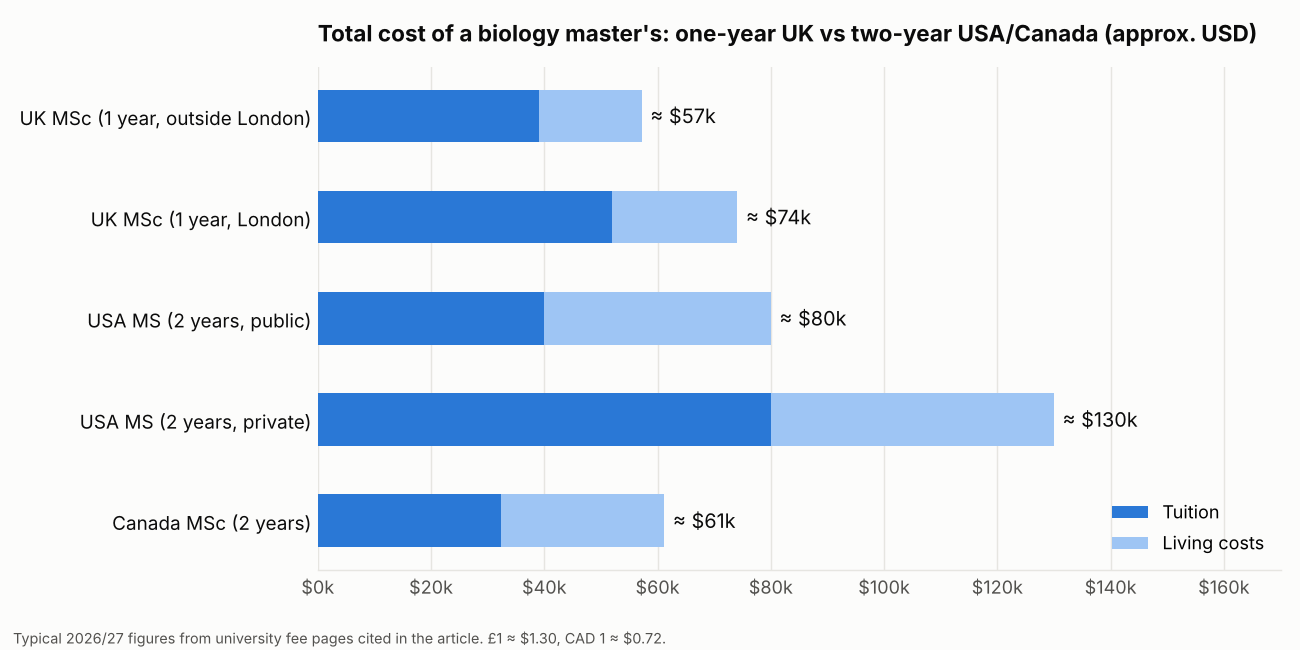
| 4. Total cost | About $57,000 all-in outside London vs $80,000–$130,000 for a two-year US MS |
| 5. No GRE | Admission on degree marks (2:1 ≈ 60–65% in India; some accept 55%), IELTS 6.5 and a statement |
| 6. Life-sciences jobs | Oxford–Cambridge–London “Golden Triangle”, Manchester, Edinburgh; AstraZeneca, GSK, Wellcome Sanger, NHS labs |
| 7. Post-study work | Graduate Route: 24 months if you apply before 1 Jan 2027, 18 months after; PhD graduates keep 3 years |
| 8. Less competition now | International postgraduate enrolment fell 10% in 2024/25; Indian PG enrolment fell 13%, so offers and scholarships are easier to win |
1. A One-Year Master’s Saves a Full Year of Time and Money
The single biggest reason is length. A UK taught MSc is 12 months full-time (September to September, with a summer research project). A comparable MS in the USA or MSc in Canada usually takes two years. That means one year of rent instead of two, one year less out of the job market, and an earlier start on your career or PhD.
2. World-Class Biology Departments
In the QS World University Rankings by Subject 2026 for Biological Sciences, every university in the global top ten is in the UK or the USA, and Oxford is the highest-ranked UK institution. Cambridge, Imperial College London, UCL, Edinburgh, King’s College London and Manchester are all consistently in the global top 50 for life sciences. Beyond the big names, universities such as Dundee (drug discovery), Glasgow (infection and immunity), Sheffield (molecular biology) and Leeds (structural biology) have specialist research groups that rank among the best in their niche.
For a master’s student this matters because your summer research project is done inside those labs. A strong project and supervisor reference is what gets you a PhD offer or an industry job.
3. Specialised MSc Programmes You Can’t Easily Find Elsewhere
UK universities offer very focused one-year degrees. Popular choices for biology graduates include:
- MSc Biotechnology – Edinburgh, Manchester Metropolitan, Imperial, UCL, Nottingham
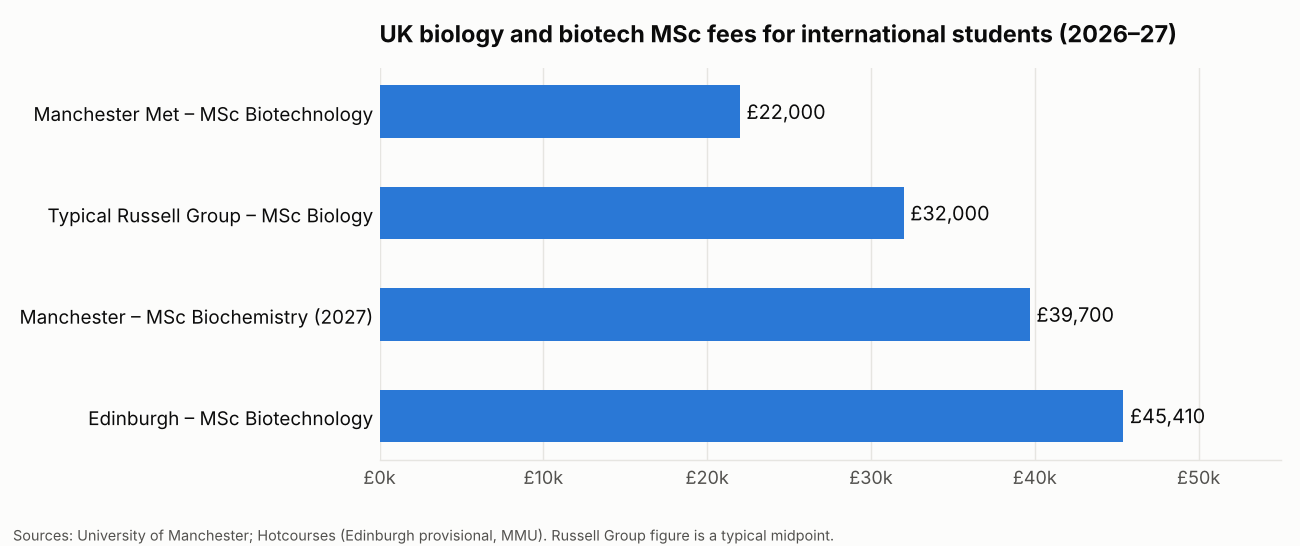
- MSc Molecular Biology / Biochemistry – Manchester (Biochemistry £39,700 for 2027 entry, 12 months), Glasgow, Leeds, Sheffield
- MSc Genetics / Genomic Medicine – Imperial, Cambridge, Leicester, Birmingham
- MSc Bioinformatics / Computational Biology – Edinburgh, Glasgow, Birmingham, Leeds (high demand in pharma and AI drug discovery)
- MSc Microbiology / Infection Biology – Glasgow, Manchester, King’s College London, London School of Hygiene & Tropical Medicine
- MSc Cancer Biology / Molecular Biomedicine – Manchester, UCL, Newcastle
- MSc Ecology, Conservation, Marine Biology – Imperial, Exeter, Aberdeen, Bangor
- MSc Neuroscience – UCL, King’s, Edinburgh, Oxford
4. What a UK Biology MSc Actually Costs (2026/27)
| Cost item | Outside London | London |
|---|---|---|
| Tuition (international) | £17,000–£40,000 | £30,000–£45,000 |
| Living costs (12 months) | £12,000–£15,000 | £16,000–£18,000 |
| Visa maintenance proof (9 months) | £1,171 × 9 = £10,539 | £1,529 × 9 = £13,761 |
| Student visa fee | £524 | £524 |
| Immigration Health Surcharge | £776 per year | £776 per year |
| Typical total | £35,000–£55,000 | £48,000–£65,000 |
Scholarships that bring the cost down
- Chevening – fully funded one-year master’s; needs two years’ work experience; 2027 applications ran 4 August – 6 October 2026.
- Commonwealth Master’s Scholarships – full funding for eligible Commonwealth countries (India, Pakistan, Bangladesh, Nigeria, Kenya, Sri Lanka and others) via national nominating agencies.
- GREAT Scholarships – £10,000 at selected universities for students from specific countries.
- University awards – automatic international discounts of £2,000–£10,000 at Manchester, Leeds, Sheffield, Glasgow, Nottingham, Birmingham and most post-1992 universities.
- Education loans – Indian public-sector banks lend up to ₹1.5 crore for listed UK universities.
5. Easy Entry: No GRE, Flexible Requirements
- Degree: a bachelor’s in biology, biotechnology, biochemistry, microbiology, zoology, botany, genetics, life sciences or related. Three-year Indian BSc degrees are accepted.
- Marks: 2:1 equivalent (about 60–65% from a recognised Indian university) for Russell Group; 2:2 (about 55%) at many post-1992 universities.
- English: IELTS 6.5 overall with no band below 6.0 for most programmes; PTE Academic and TOEFL accepted; some universities accept Class 12 English or medium-of-instruction letters for admission (the visa may still need a SELT).
- Documents: transcripts, degree certificate, statement of purpose (500–800 words), two references, CV.
- No GRE, no entrance exam.
Applications are made directly to each university (not UCAS). Most biology MScs are rolling: apply between October and March for September entry, earlier if you want scholarships.
6. Strong Career Prospects in UK Life Sciences
The UK has one of Europe’s largest life-sciences sectors, concentrated in the Oxford–Cambridge–London “Golden Triangle”, plus clusters in Manchester, Edinburgh, Dundee and Cardiff. Employers that hire MSc biology graduates include AstraZeneca, GSK, Oxford Biomedica, Abcam, Illumina UK, Wellcome Sanger Institute, the Francis Crick Institute, contract research organisations (Charles River, IQVIA) and NHS laboratories.
- Research scientist (biotechnology): median £37,000; range £26,000–£55,000 (PayScale 2026).
- NHS Band 5 biomedical scientist: £34,494–£42,977; Band 6 specialist £43,169–£52,603 (April 2026 scales).
- Bioinformatics and data roles: often £35,000–£50,000 at entry because of the overlap with AI and drug-discovery companies.
- PhD: a UK MSc with a strong project is the standard route into a funded UK, European or US PhD, which usually pays a tax-free stipend.
7. Post-Study Work: The Graduate Route (and the 2027 Change)
After your MSc you can apply for the Graduate visa, which lets you work at any level, for any employer, with no sponsor. The key date:
- Apply before 1 January 2027: 24 months.
- Apply on or after 1 January 2027: 18 months (bachelor’s and master’s). PhD graduates keep 3 years.
Anyone starting an MSc in September 2026 or 2027 will finish after January 2027, so plan for 18 months. That is still enough to move into a Skilled Worker visa if you land a graduate job; start applying to graduate schemes and lab roles from January of your MSc year, not after the dissertation.
8. Less Competition Right Now
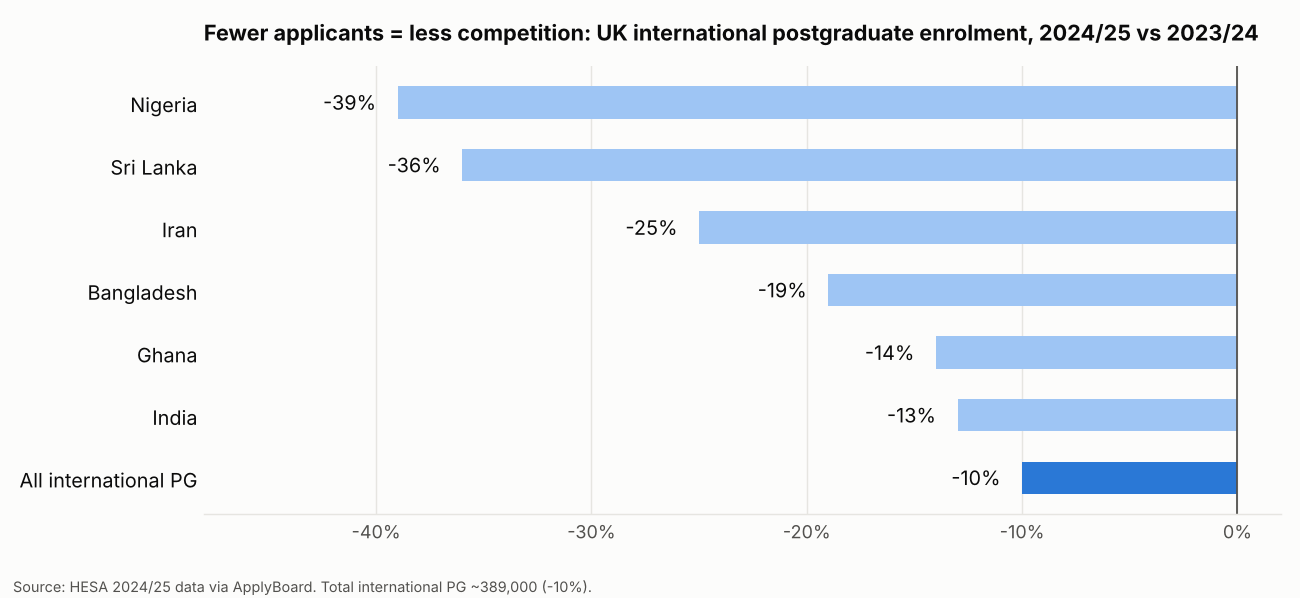
HESA data for 2024/25 show nearly 686,000 international students in the UK (down 6%), with postgraduates at about 389,000 (down 10%). Enrolment from India fell 13%. For a well-qualified biology applicant this is good news: popular MSc programmes are easier to get into than in 2022–23, and more universities are offering automatic discounts.
UK vs USA vs Canada for a Biology Master’s
| Factor | UK | USA | Canada |
|---|---|---|---|
| Length | 1 year | 2 years | 1.5–2 years (thesis) |
| Total cost (approx.) | $57,000–$74,000 | $80,000–$130,000 | $60,000–$75,000 (thesis MSc often funded) |
| GRE | Not required | Mostly optional | Rarely required |
| Post-study work | 18 months (from 2027) | 36 months (STEM OPT) | Up to 3 years (PGWP) |
| Funding | Chevening, Commonwealth, university discounts | Assistantships at research universities | Thesis MScs often include a stipend |
| Best for | Fast, focused, cost-efficient degree; PhD pipeline | Long work rights, biggest biotech job market | Funded research MSc; PR pathway |
Honest Downsides to Consider
- The Graduate Route is shorter from 2027 (18 months).
- One year is intense: little time for internships during the course.
- London is expensive; consider Manchester, Leeds, Glasgow, Sheffield or Edinburgh.
- Student dependants are not allowed on taught master’s visas (since January 2024), so you cannot bring a spouse unless on a research degree.
- Skilled Worker salary thresholds are high for some entry-level lab roles, so research the visa sponsors in your field.
Step-by-Step: How to Apply for a UK Biology Master’s
- Choose your specialism (biotech, genetics, bioinformatics, microbiology) and shortlist 5–6 programmes across Russell Group and post-1992 universities.
- Check the entry rule for your degree and percentage on each course page.
- Take IELTS Academic (UKVI version if the university asks) and aim for 6.5 with 6.0 in each band.
- Write a targeted statement: name the lab techniques you know, a research question you want to explore, and the modules or supervisors that attract you.
- Apply online directly to each university between October and March; pay any application fee (£0–£80).
- Apply for scholarships at the same time (university awards, GREAT, Commonwealth; Chevening opens each August).
- Accept, pay the deposit (usually £2,000–£5,000), receive your CAS.
- Apply for the Student visa with funds held for 28 days, TB test if required, and fly for a September (or January) start.
Frequently Asked Questions
Is a UK master’s in biology recognised in India and abroad?
Yes. UK MSc degrees from recognised universities are accepted for jobs, PhD admissions and further study worldwide, including in India, the USA, Canada, the EU and Australia.
Can I get a UK MSc with 55% in my BSc?
Yes, at many post-1992 universities that accept a 2:2 equivalent (around 55%). Russell Group universities usually ask for 60–65%.
Is a one-year master’s enough for a PhD?
Yes. UK MSc graduates routinely enter PhDs in the UK, Europe and the USA, especially with a strong research project and reference.
How much can I earn after a UK biology MSc?
Typical starting salaries are £28,000–£38,000 in research and industry; NHS Band 5 starts at £34,494; bioinformatics roles often pay more.
Can I bring my family on a UK MSc visa?
Not on a taught master’s. Since January 2024 only research degree (PhD, research master’s) students can bring dependants.
Which UK city is cheapest for biology students?
Glasgow, Sheffield, Leeds, Manchester, Newcastle and Cardiff are significantly cheaper than London, Oxford, Cambridge and Edinburgh city centre.
When should I apply for September 2027?
Between October 2026 and March 2027 for the best chance of scholarships; many programmes stay open until June–July 2027 if places remain.
Bottom Line
For most biology graduates, the UK offers the fastest and most cost-efficient route to a respected master’s, with world-class labs and a real job market, at a moment when competition for places has eased. The trade-off is a shorter 18-month work visa from 2027, so treat the job search as part of the course. If long work rights matter more than speed and cost, compare the US STEM OPT and Canadian PGWP routes before you decide.
Related guides
- How to Apply for a Master’s in Biotechnology in the USA & UK (2026)
- How to Join Top Biotechnology Programs in the USA, UK & Canada
- How To Start Biomedical Studies Abroad In 2026
- Affordable Foundation Courses for International Students in the UK & USA
Sources: QS World University Rankings by Subject 2026 – Biological Sciences; University of Manchester – MSc Biochemistry fees; Edinburgh MSc Biotechnology (Hotcourses); ApplyBoard – UK international postgraduate enrolment 2024/25 (HESA); BUILA – Graduate Route 18 months from 2027; Chevening 2027 dates (University of Leeds); PayScale – UK biotech research scientist salary 2026; PlanIt Plus – NHS biomedical scientist pay 2026. Figures checked October 2026.