A master’s in biotechnology in the USA or UK is one of the fastest ways to move from a BSc into a well-paid lab, pharma or research career. The two countries work very differently: a UK MSc takes one year and costs £22,000–£45,000, while a US MS takes one to two years, costs $30,000–$80,000, and comes with up to three years of STEM OPT work rights. This guide covers eligibility, GRE and IELTS rules, exact fees, the 2027 application timeline, Chevening and other scholarships, visas, and what graduates earn, so you can apply with confidence.
Quick Summary: MS/MSc Biotechnology in the USA vs UK (2026–27)
| Factor | USA (MS) | UK (MSc) |
|---|---|---|
| Duration | 1–2 years (30–40 credits) | 1 year (12 months, with dissertation) |
| Tuition (international) | $30,000–$80,000 total | £22,000–£45,410 total |
| Degree needed | 4-year bachelor’s, GPA 3.0+ (≈ 65–70% in India) | 2:1 honours (≈ 60–65%); some accept 2:2 (55%) |
| GRE | Optional or not required at most universities in 2026 | Not required |
| English test | TOEFL 80–100 / IELTS 6.5–7.0 | IELTS 6.5 overall (6.0 in each band) |
| Deadlines (Fall 2027) | Dec 2026 – Feb 2027 (some rolling) | Rolling; apply by Jan–Mar 2027 for scholarships |
| Post-study work | 12 months OPT + 24 months STEM extension = 36 months | Graduate Route 18 months (applications from 1 Jan 2027) |
| Big scholarships | University assistantships, Fulbright-Nehru | Chevening, Commonwealth, GREAT, university awards |
Is a Master’s in Biotechnology Worth It in 2026?
Yes, if you want to work in drug development, diagnostics, genomics, bioprocessing, agri-biotech or regulatory affairs. Biotechnology sits at the centre of the fastest-growing parts of healthcare: mRNA vaccines, cell and gene therapy, CRISPR, biosimilars and AI-driven drug discovery. The US Bureau of Labor Statistics projects 13% growth for medical scientists between 2025 and 2035, and UK biotech research scientists earn a median of £37,000 with a top-decile around £55,000. A master’s is also the normal entry ticket to a funded PhD and to R&D roles that a bachelor’s alone rarely reaches.
Step 1: Check Your Eligibility
Academic background
- USA: a four-year bachelor’s in biotechnology, biochemistry, microbiology, biology, chemistry, pharmacy, bioengineering or a related science. Three-year Indian BSc degrees are accepted by many universities for an MS in biotechnology, but some (especially top-ranked programmes) ask for a four-year degree or a BSc + one year of MSc. A GPA of 3.0/4.0 (roughly 65–70%) is the usual floor; competitive programmes want 3.5+.
- UK: a 2:1 honours degree (about 60–65% from a recognised Indian university) in a life-science subject. Universities such as Manchester Metropolitan accept a 2:2 (55%+), while Edinburgh, Imperial, UCL and Manchester expect a strong 2:1 with evidence of lab and quantitative skills. Three-year Indian degrees are fully accepted in the UK.
Tests
- GRE: most US biotech MS programmes, including Johns Hopkins, no longer require it. A good score (315+) still helps if your GPA is borderline. UK universities never ask for it.
- English: Johns Hopkins asks for TOEFL iBT 100 or IELTS 7.0; most US public universities accept TOEFL 80–90 or IELTS 6.5. UK MSc courses typically require IELTS 6.5 overall with no band below 6.0; many also accept PTE Academic (58–62) or a Medium of Instruction letter from Indian universities for the Student visa (but check each university).
Work experience
Not required for admission, but one to two years in a lab, CRO, pharma QC or clinical research team strengthens your statement and is mandatory for Chevening (minimum two years or 2,800 hours after your degree).
Step 2: Understand the Real Cost
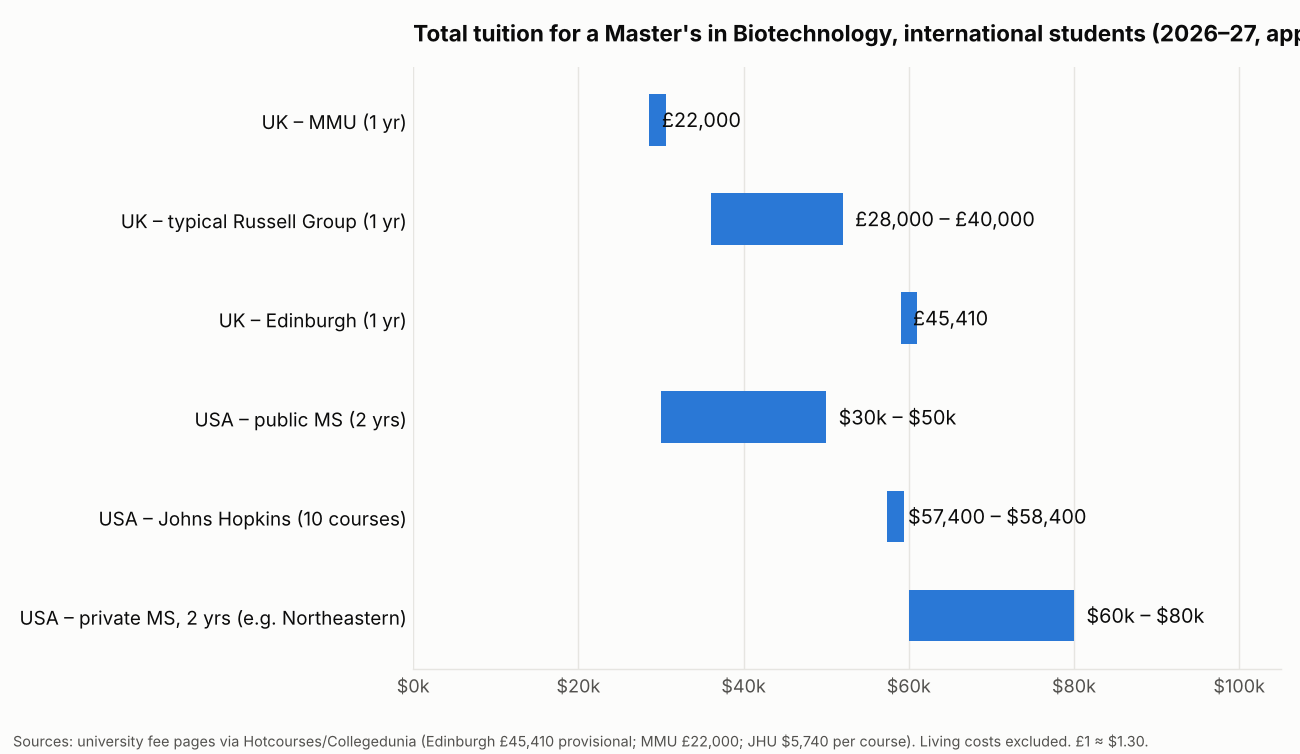
United Kingdom
| University (MSc Biotechnology) | Tuition 2026/27 (international) | Entry |
|---|---|---|
| University of Edinburgh | £45,410 (provisional) | 2:1, strong quantitative skills |
| Imperial College London / UCL | £38,000–£45,000 | 2:1 (often 1st preferred) |
| University of Manchester, Leeds, Nottingham, Sheffield | £28,000–£36,000 | 2:1 |
| Manchester Metropolitan, Northumbria, Coventry, Hertfordshire | £17,000–£22,000 | 2:2 accepted |
Add living costs of roughly £12,000–£15,000 outside London and £16,000–£18,000 in London. For the visa you must show £1,171 per month (outside London) or £1,529 per month (London) for nine months, on top of your first-year fees. The Immigration Health Surcharge is £776 per year and the visa fee is £524.
United States
| University (MS Biotechnology) | Tuition (total programme) | Notes |
|---|---|---|
| Johns Hopkins University | $57,400 (10 courses × $5,740) | No GRE; TOEFL 100 / IELTS 7.0; rolling intakes (Fall, Spring, Summer) |
| Northeastern University | $60,000–$80,000 | 3–6 month paid co-op built in |
| University of Pennsylvania, Columbia, Georgetown | $65,000–$90,000 | Top-tier, strong pharma links |
| Public universities (Texas A&M, Rutgers, Illinois Chicago, Arizona State) | $30,000–$50,000 | Best value; assistantships possible |
Living costs run $15,000–$25,000 per year (Johns Hopkins estimates $24,305 for nine months in Baltimore). Add the SEVIS fee ($350), visa fee ($185) and mandatory health insurance ($1,500–$2,500 per year).
Step 3: Choose the Right Programme Type
- Thesis / research MSc: best if you plan a PhD. Includes a 3–4 month lab project. Common at Edinburgh, Manchester, Imperial, and US research universities.
- Professional / industry MS: coursework plus internship or co-op; prepares you for jobs in bioprocessing, QA/QC, regulatory affairs and biotech business. Johns Hopkins, Northeastern (co-op), Georgetown and most UK “Biotechnology and Enterprise” courses fit here.
- Specialised tracks: bioinformatics, pharmaceutical biotechnology, medical biotechnology, industrial/bioprocess engineering, and biotech management. Pick one that matches a job title you can name.
Step 4: Prepare Your Documents
- Statement of purpose (SOP): 800–1,000 words for the US, 500–800 for the UK. State the problem you want to work on (for example, scalable monoclonal antibody production), the specific skills you have (PCR, HPLC, cell culture, Python/R), why this university’s labs or industry links fit, and your five-year goal.
- Two or three recommendation letters: at least one from a professor who supervised your lab project; one from an employer if you have worked.
- Academic CV: one to two pages with projects, techniques, publications or posters, and software skills.
- Transcripts and degree certificate: US universities often require a WES or ECE evaluation; UK universities usually accept originals plus certified copies.
- English test score: valid for two years.
- Passport copy and financial documents: needed at the I-20 or CAS stage, not at application.
Step 5: Apply on Time (Timeline for September 2027)
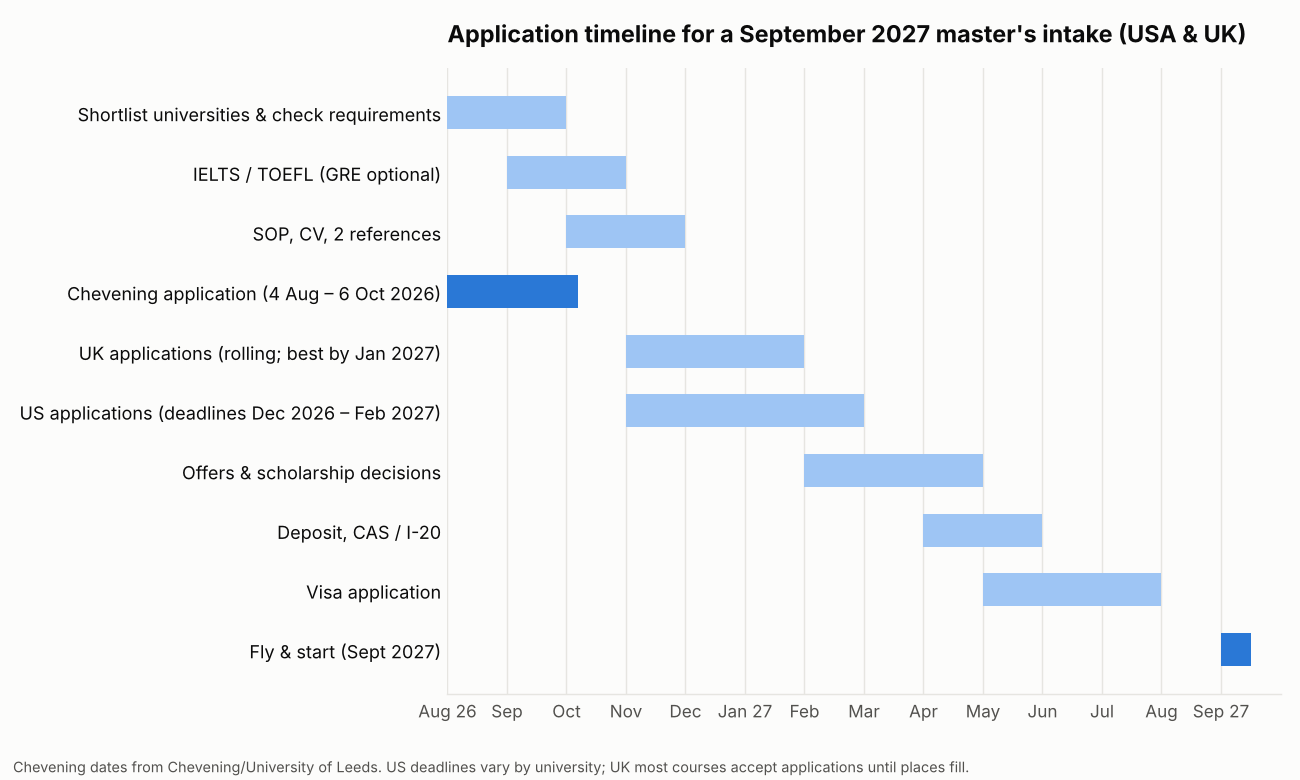
| Milestone | When |
|---|---|
| Chevening 2027 applications | 4 August – 6 October 2026 (11am UTC) |
| IELTS / TOEFL | By October–November 2026 |
| US early-action deadlines | 1 December – 20 December 2026 |
| US regular deadlines | 15 January – 20 February 2027 (Johns Hopkins is rolling; apply 3 months before start) |
| UK applications | Rolling; submit by January–March 2027 for scholarship eligibility and before popular courses close (often June 2027) |
| Commonwealth Master’s Scholarship (UK) | Usually opens September, closes mid-October to December, via nominating agency |
| Offers | February – May 2027 |
| Deposit, CAS (UK) / I-20 (US) | April – June 2027 |
| Visa application | May – July 2027 (UK: up to 6 months before; US: book interview early) |
| Course starts | September 2027 (US also offers January/Spring intakes) |
Step 6: Scholarships and Funding
- Chevening (UK): fully funded (fees, living allowance, flights) for one-year master’s. Needs two years of work experience. Applications for 2027 run 4 August – 6 October 2026.
- Commonwealth Master’s Scholarships (UK): full funding for candidates from Commonwealth countries including India, Pakistan, Bangladesh, Nigeria and Sri Lanka; apply through the national nominating agency.
- GREAT Scholarships and university awards (UK): £10,000 GREAT awards at selected universities, plus automatic international merit discounts of £3,000–£10,000 at most UK universities.
- Fulbright-Nehru Master’s Fellowships (USA): full funding for Indian citizens with three years’ work experience; biotech is an eligible field. Applications usually open February and close mid-May for the following year.
- Graduate assistantships (USA): teaching or research assistantships at public universities can waive tuition and pay a stipend; ask the department directly before applying.
- Inlaks, J.N. Tata Endowment, KC Mahindra (India): loans and grants for study abroad in science.
- Education loans: Indian public-sector banks lend up to ₹1.5 crore for listed universities; compare interest rates, collateral rules and moratorium periods.
Step 7: Get Your Visa
UK Student visa
Your university issues a CAS once you accept the offer and pay the deposit. You then apply online with your passport, CAS number, financial evidence (first-year fees plus maintenance held for 28 days), TB certificate (for Indian and South Asian applicants), and English evidence. Fee £524 plus £776 per year IHS. Decisions normally take three weeks.
US F-1 visa
After the I-20, pay the SEVIS fee ($350), complete the DS-160, pay the visa fee ($185) and attend your interview. Carry bank statements or a loan sanction letter covering at least the first year, your admission letter, transcripts and test scores. Be clear about your course, funding and career plan.
Step 8: Careers and Salaries After the Degree
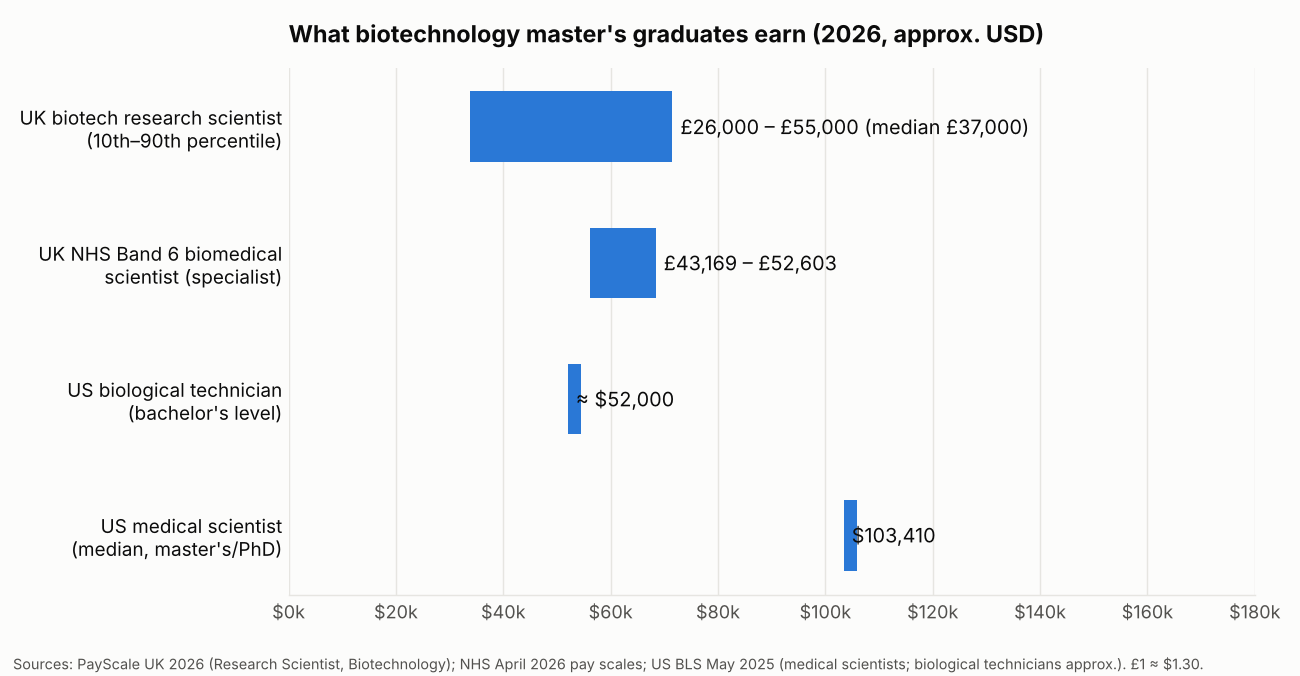
- UK: research scientist (biotechnology) median £37,000, range £26,000–£55,000; NHS clinical scientist or Band 6 biomedical scientist £43,169–£52,603; regulatory affairs and bioprocess engineers at AstraZeneca, GSK, Oxford Biomedica and Lonza typically £35,000–£50,000 for master’s graduates.
- USA: research associate or process development scientist $65,000–$90,000 in biotech hubs (Boston, San Francisco, San Diego, Research Triangle); medical scientists overall median $103,410; bioinformatics and data roles often higher.
- Work rights: US graduates get 12 months OPT plus a 24-month STEM extension (biotechnology is on the STEM list), so up to 36 months before needing H-1B sponsorship. UK graduates who apply for the Graduate Route on or after 1 January 2027 get 18 months, so start applying to graduate schemes in the second semester.
- Further study: a master’s with a research project is the standard route into funded PhDs in both countries, as well as into graduate-entry medicine for some applicants.
Common Mistakes Applicants Make
- Applying only to top-10 universities without checking whether a three-year degree is accepted.
- Missing the Chevening window (it closes before most university deadlines even open).
- Writing a generic SOP that never names a technique, a lab, or a job title.
- Ignoring living-cost proof for the visa: the UK wants the money held for 28 consecutive days.
- Choosing a research MSc when you want an industry job, or vice versa.
- Forgetting that the UK Graduate Route shrinks to 18 months for 2027 applications, which changes how early you must job-hunt.
Frequently Asked Questions
Can I do a master’s in biotechnology in the UK after a 3-year BSc from India?
Yes. UK universities accept three-year Indian bachelor’s degrees for MSc entry, usually at 60–65% for a 2:1 equivalent or 55% for a 2:2 equivalent.
Is GRE compulsory for MS in biotechnology in the USA?
No. In 2026 most US biotech programmes, including Johns Hopkins, do not require the GRE. A few research-heavy programmes still recommend it.
Which is cheaper, the USA or the UK?
The UK, because the MSc is one year. A typical UK MSc costs £22,000–£36,000 plus £12,000–£15,000 living; a US MS costs $30,000–$80,000 plus $15,000–$25,000 per year living.
Which country gives better job options after biotechnology?
The USA has the largest biotech job market and 36 months of STEM OPT; the UK has strong pharma (Cambridge, Oxford, London) but only 18 months on the Graduate Route from 2027. If you want to return to India, both degrees are well recognised.
What IELTS score do I need?
UK: 6.5 overall, 6.0 in each band at most universities. USA: 6.5–7.0; Johns Hopkins requires 7.0.
Can I work during the master’s?
Yes. UK: 20 hours a week in term time. USA: 20 hours a week on campus, plus CPT internships related to your course after the first year.
Are there January intakes?
Many US universities (including Johns Hopkins and Northeastern) offer Spring/January intakes. UK MSc biotech courses are mostly September-only, with a few January starts at post-92 universities.
Final Checklist
- Confirm your degree and percentage meet the entry rule for each university.
- Book IELTS/TOEFL for October–November 2026.
- Decide research vs professional track and shortlist 6–8 programmes across both countries.
- Apply for Chevening by 6 October 2026 if you have two years’ experience.
- Submit US applications by December 2026–January 2027 and UK applications by January–March 2027.
- Line up funding: scholarships, assistantships, or a sanctioned loan.
- Pay the deposit, get your CAS or I-20, and apply for the visa by June 2027.
Apply early, pick the programme type that matches the job you want, and treat the scholarship calendar as seriously as the university calendar. Do that and a master’s in biotechnology in the USA or UK in 2027 is well within reach.
Related guides
- How To Start Biomedical Studies Abroad In 2026
- How to Join Top Biotechnology Programs in the USA, UK & Canada
- How to Join Medical Foundation Programs in the USA and UK
- Affordable Foundation Courses for International Students in the UK & USA
Sources: Edinburgh MSc Biotechnology fees (Hotcourses); Manchester Metropolitan MSc Biotechnology fees; Johns Hopkins MS Biotechnology fees and requirements; Northeastern MS Biotechnology; Chevening 2027 dates (University of Leeds); PayScale – UK biotechnology research scientist salary 2026; US BLS – Medical Scientists; BUILA – Graduate Route 18 months from 2027. Figures checked October 2026; confirm on official university pages before applying.