Studying biomedical science abroad is one of the most practical routes into medical research, diagnostics, biotechnology and pharma. In 2026 the rules have changed in almost every popular country: the UK is shortening its post-study work visa from January 2027, Canada has cut its study-permit cap again, and the US is still the highest-paying destination for medical scientists. This guide walks you through every step: picking a country, meeting entry requirements, paying for it, applying on time, getting the visa, and what you can earn afterwards.
Quick Summary: Biomedical Studies Abroad in 2026
| Question | Short answer (2026) |
|---|---|
| Best countries | UK, USA, Canada, Germany, Australia, Ireland, Netherlands |
| Degree length | 3 years (UK, Germany, most of Europe), 4 years (USA, Canada) |
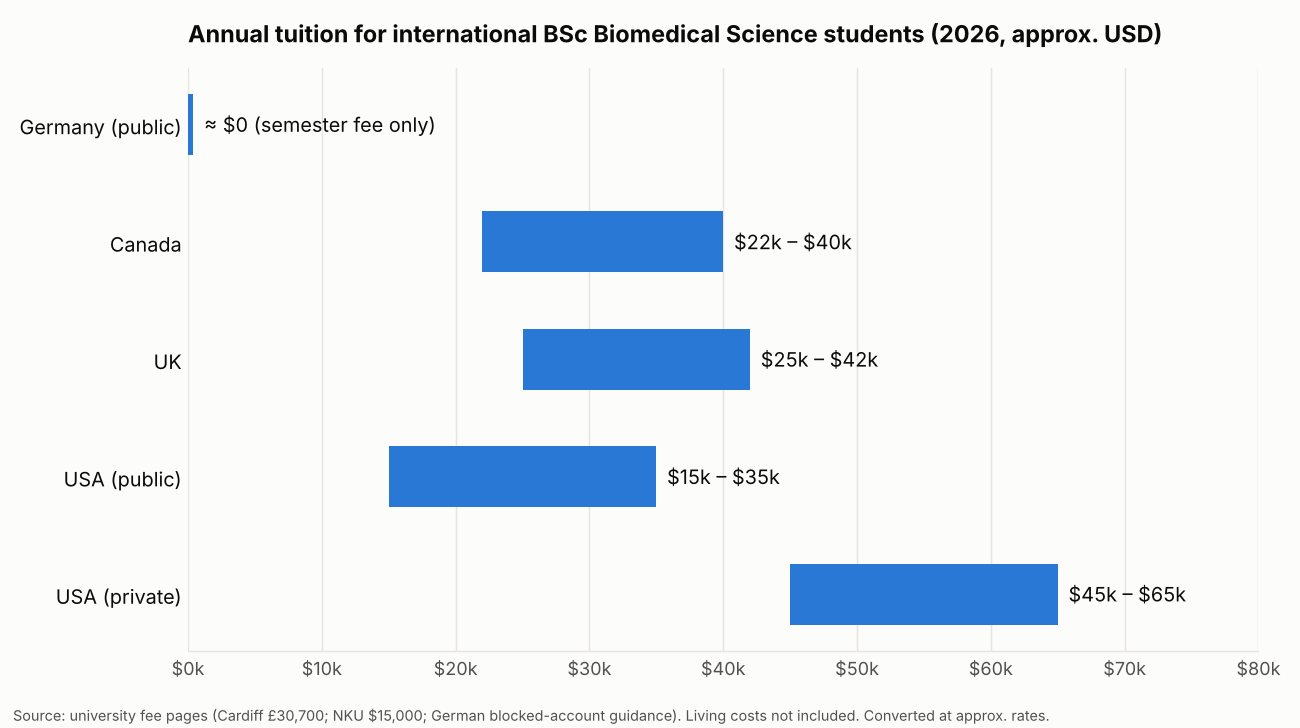
| Tuition per year | £25,000–£33,000 UK; $15,000–$65,000 USA; CAD 30,000–55,000 Canada; almost free at German public universities |
| Subjects you need | Biology and Chemistry at 12th / A-level / IB level |
| English test | IELTS 6.0–6.5 (UK), TOEFL 80–100 or Duolingo 110–120 (USA) |
| Main deadlines | UCAS 14 Jan 2026 (2026 entry) / 13 Jan 2027 (2027 entry); US early action 1 Nov, regular 1–15 Jan |
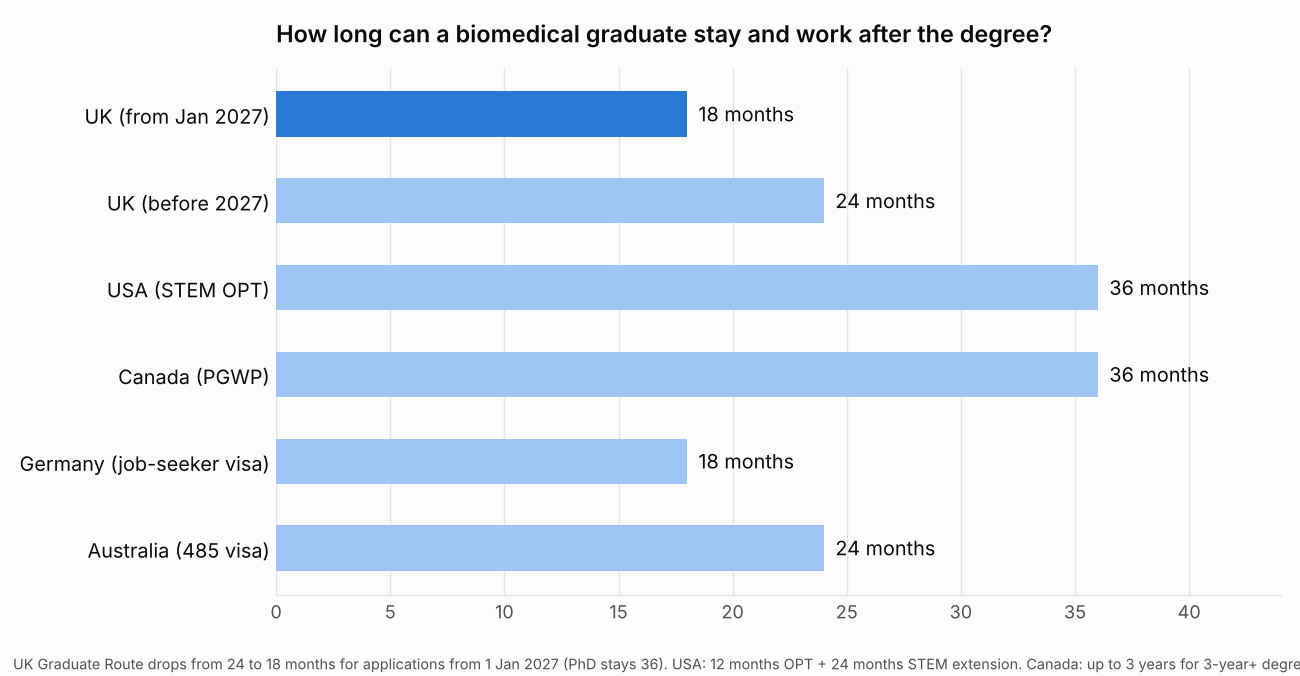
| Post-study work | UK 18 months (from 1 Jan 2027), USA up to 36 months (STEM OPT), Canada up to 3 years, Germany 18 months |
| Starting salary | UK NHS Band 5: £34,494–£42,977; US medical scientists median: $103,410 |
What Is Biomedical Science and Who Should Study It?
Biomedical science is the study of how the human body works and what goes wrong in disease. A typical BSc covers anatomy, physiology, biochemistry, microbiology, immunology, genetics, pharmacology and pathology, with lab work every week. It is different from an MBBS: you do not become a doctor, but you become the scientist who runs diagnostic tests, develops drugs, analyses genomes, or leads research.
You are a good fit for biomedical studies abroad if you:
- enjoy biology and chemistry and want a career in labs, hospitals, pharma or research;
- want a faster, cheaper path than medicine but still inside healthcare;
- plan to do a master’s or PhD later (biomedical science is the standard feeder degree);
- want an internationally recognised degree with strong post-study work options.
Why 2026 Is a Turning Point for International Students
Three policy changes make 2026 different from any earlier year:
- UK Graduate Route cut to 18 months. Anyone applying for the Graduate visa on or after 1 January 2027 gets 18 months instead of 2 years. PhD graduates keep 3 years. If you start a 3-year BSc in September 2026, you will graduate in 2029 and fall under the new 18-month rule, so plan your job search from year two.
- Canada’s 2026 study-permit cap is 408,000, 7% lower than 2025 and 16% lower than 2024. Only about 155,000 permits are for brand-new students. Early, complete applications matter more than ever.
- UK maintenance funds went up on 11 November 2025: you must now show £1,529 per month for London or £1,171 per month elsewhere, on top of first-year tuition, when you apply for the Student visa.
None of these changes closes the door. They simply reward students who apply early, choose the right country for their budget, and understand the visa rules before they land.
Step 1: Choose the Right Country for Your Budget and Goals
There is no single best country. The right one depends on how much you can spend per year, how long you want to stay after graduating, and whether you want a research-heavy or job-ready degree.
United Kingdom
The UK is the most popular choice for Indian and South Asian students because the BSc takes only three years and the degree is accredited by the Institute of Biomedical Science (IBMS), which is the route to registering as a biomedical scientist with the HCPC. Fees for 2026 entry are typically £25,000–£33,000 per year. Cardiff University, for example, charges £30,700 for 2026/27 and asks for AAB–ABB at A-level, 32–34 IB points, or roughly 78–81% in Indian Class XII (best four subjects), plus IELTS 6.5 with no band below 5.5.
Strong IBMS-accredited options include Cardiff, Manchester, Birmingham, Leeds, Bristol (UWE), Brighton, Sheffield Hallam and Nottingham Trent. Budget another £13,000–£18,000 per year for living costs (more in London).
United States
US degrees take four years and are more flexible: you can major in biomedical sciences and add a minor in data science, public health or business. Costs vary enormously. Public universities such as Northern Kentucky University list total annual cost of attendance around $30,850 (tuition $15,000), while private research universities often exceed $60,000 all-in. The big advantage is the STEM OPT extension: biomedical science is a STEM field, so you can work for 12 months of OPT plus 24 months of extension, up to 36 months in total. The US also pays the most: medical scientists earned a median $103,410 in May 2025, with 13% job growth projected to 2035.
Canada
Canada remains attractive for its Post-Graduation Work Permit (up to three years for a four-year degree) and lower fees than the US, usually CAD 30,000–55,000 per year. The 2026 cap of 408,000 permits means provinces have fewer spots, so apply in the first intake window and make sure your college is a Designated Learning Institution with a Provincial Attestation Letter. Top biomedical programmes: University of Toronto, McGill, UBC, University of Alberta, Western University and University of Waterloo.
Germany
Germany is the budget option. Most public universities charge no tuition, only a semester contribution of about €70–€430 that usually includes a public transport ticket. You do need a blocked account (Sperrkonto) showing €992 per month, €11,904 for the year, plus health insurance of roughly €141–€151 per month. English-taught biomedical bachelor’s programmes exist at Otto von Guericke University Magdeburg and a growing list of universities of applied sciences, but many bachelor’s courses are still in German, so check the language of instruction carefully. After graduating you get an 18-month job-seeker visa.
Australia, Ireland and the Netherlands
Australia offers 3-year BSc degrees (AUD 40,000–50,000 per year) and a Temporary Graduate (subclass 485) visa of around two years for bachelor’s graduates. Ireland (Trinity College Dublin, University College Cork) gives EU-recognised degrees with a two-year stay-back option. The Netherlands has excellent English-taught biomedical sciences programmes (Maastricht, Groningen, Utrecht) at around €12,000–€20,000 per year.
Step 2: Check the Entry Requirements
Admissions teams look at four things: your science grades, your overall percentage, your English test, and your personal statement or essay.
| Requirement | UK | USA | Canada | Germany |
|---|---|---|---|---|
| Subjects | Biology + Chemistry at A-level / Class XII | Biology, Chemistry, Maths recommended | Biology, Chemistry, Maths (Grade 12) | Biology + Chemistry; Abitur-equivalent (often Studienkolleg for Indian 12th) |
| Typical grades | AAB–BBB; Indian 12th 75–85% | GPA 3.0–3.7; 80%+ for selective schools | 80–90% in Grade 12 | Good 12th + JEE/entrance or 1 year of university |
| English test | IELTS 6.0–6.5 (5.5 min per band) | TOEFL 80–100 / IELTS 6.5 / Duolingo 110–120 | IELTS 6.5 / TOEFL 86+ | IELTS 6.0–6.5 for English-taught courses |
| Other tests | None for BSc | SAT/ACT optional at most universities in 2026 | None | TestAS at some universities |
| Documents | UCAS form, personal statement, 1 reference | Common App, essays, 2–3 recommendations | Online application, transcripts, statement | Uni-assist or direct, APS certificate for India |
Tip for Indian students: CBSE and ISC boards are accepted directly by UK, US and Canadian universities. State boards are also accepted but some UK universities ask for a higher percentage. If you are applying to Germany, you will need the APS certificate from the German Embassy before you can apply for a visa.
Step 3: Work Out the Real Cost (Tuition + Living + Visa)
Tuition is only half the bill. Here is a realistic first-year budget for 2026 so you can compare countries properly.
| Cost item (year 1) | UK (outside London) | USA (public) | Canada | Germany |
|---|---|---|---|---|
| Tuition | £28,000 | $15,000–$25,000 | CAD 40,000 | €0–€400 |
| Living (9–12 months) | £10,500–£14,000 | $12,000–$16,000 | CAD 15,000–20,000 | €11,904 (blocked account) |
| Visa fee | £524 | $185 + $350 SEVIS | CAD 150 + biometrics | €75 |
| Health cover | IHS £776/year | $1,500–$2,500 | Provincial / ~CAD 700 | €1,700–€1,800 |
| Approx. total | £40,000–£44,000 | $30,000–$45,000 | CAD 56,000–62,000 | €14,000–€15,000 |
Fees quoted are 2025/26 and 2026/27 published figures where available; universities announce 2027/28 fees between January and April 2027, so always confirm on the official course page before you accept an offer.
Scholarships and Funding for Biomedical Students
- University merit scholarships (UK): most universities give automatic £2,000–£5,000 per year to international students with strong grades, and a few offer 50% fee discounts for top applicants.
- US merit aid: many public universities offer $5,000–$20,000 per year for a GPA above 3.5; private universities sometimes offer need-based aid to internationals (check the Common Data Set).
- Canada: entrance scholarships of CAD 2,000–10,000 are common; the Lester B. Pearson scholarship at Toronto covers full costs for a handful of students.
- Germany: DAAD scholarships mostly target master’s and PhD, but Deutschlandstipendium (€300 per month) is open to bachelor’s students once enrolled.
- Education loans: Indian banks and NBFCs fund up to 100% of cost for recognised universities; compare rates and moratorium periods before you sign.
Step 4: Apply on Time (2026 and 2027 Deadlines)
Missing a deadline costs you a full year, so put these dates in your calendar now.
| Country / system | Deadline for 2026 entry | Deadline for 2027 entry |
|---|---|---|
| UK – UCAS (Oxford, Cambridge, medicine) | Passed | 15 October 2026 (6pm UK) |
| UK – UCAS main deadline (all other courses) | 14 January 2026 | 13 January 2027 |
| UK – UCAS late applications close | 30 June 2026 | 30 June 2027 |
| UK – Clearing | 2 July – 19 October 2026 | 2 July – ~18 October 2027 |
| USA – Early Action / Early Decision | Passed | 1 November 2026 (most universities) |
| USA – Regular Decision | Passed | 1–15 January 2027 |
| Canada – Fall intake | Mostly closed; some colleges open to June | 15 January – 1 March 2027 (varies by university) |
| Germany – Winter semester | 15 July 2026 (uni-assist) | 15 July 2027 |
Best timing: if you want to start in September 2027, begin shortlisting universities now, take IELTS or TOEFL by September 2026, and submit UK and US applications in October–December 2026. That gives you January–March 2027 for offers, April–May for scholarships and loans, and June–August for the visa.
Step 5: Write a Personal Statement That Gets Offers
Biomedical science admissions tutors read thousands of statements that say “I have always been fascinated by the human body.” Stand out by being specific:
- Open with a concrete moment: a lab practical, a research paper you read, a hospital visit, a family member’s diagnosis.
- Show evidence of science beyond the syllabus: online courses (Coursera, edX), science olympiads, a school project, volunteering in a clinic or pathology lab.
- Name the parts of the course that excite you (immunology, genomics, pharmacology) and link them to a career goal.
- Mention one transferable skill with proof: teamwork from a sports team, data skills from a spreadsheet project, communication from tutoring juniors.
- Keep it to 4,000 characters for UCAS, 650 words for the Common App essay, and get a teacher to proofread it.
Step 6: Get the Student Visa
UK Student visa
You need a Confirmation of Acceptance for Studies (CAS) from the university, proof of first-year tuition plus maintenance (£1,529 per month in London or £1,171 elsewhere, for up to 9 months), a TB test certificate if you are from India or South Asia, your passport, and your English test result. The fee is £524 plus the Immigration Health Surcharge (£776 per year). Apply up to six months before the course starts; decisions usually take three weeks.
US F-1 visa
After admission the university issues an I-20. You pay the SEVIS fee ($350), complete the DS-160, pay the visa fee ($185) and attend an interview at the US embassy. Be ready to explain your course, how you will fund it (bank statements covering at least one year), and your plan to return or use OPT. Book interview slots early; summer waits in India can be long.
Canada study permit
You need a Letter of Acceptance from a DLI, a Provincial Attestation Letter (your university arranges this under the cap), proof of funds (tuition plus the living-cost requirement), medical exam if required, and biometrics. Use the Student Direct Stream if you qualify for faster processing.
Germany national visa
Submit the admission letter, blocked account confirmation (€11,904), health insurance, APS certificate (for Indian students), and proof of language ability. Processing takes 6–12 weeks, so apply as soon as you receive admission.
Step 7: Plan Your Career From Day One
Biomedical science pays well because it sits between healthcare and the pharma industry, both of which are growing. Here is what graduates typically earn.
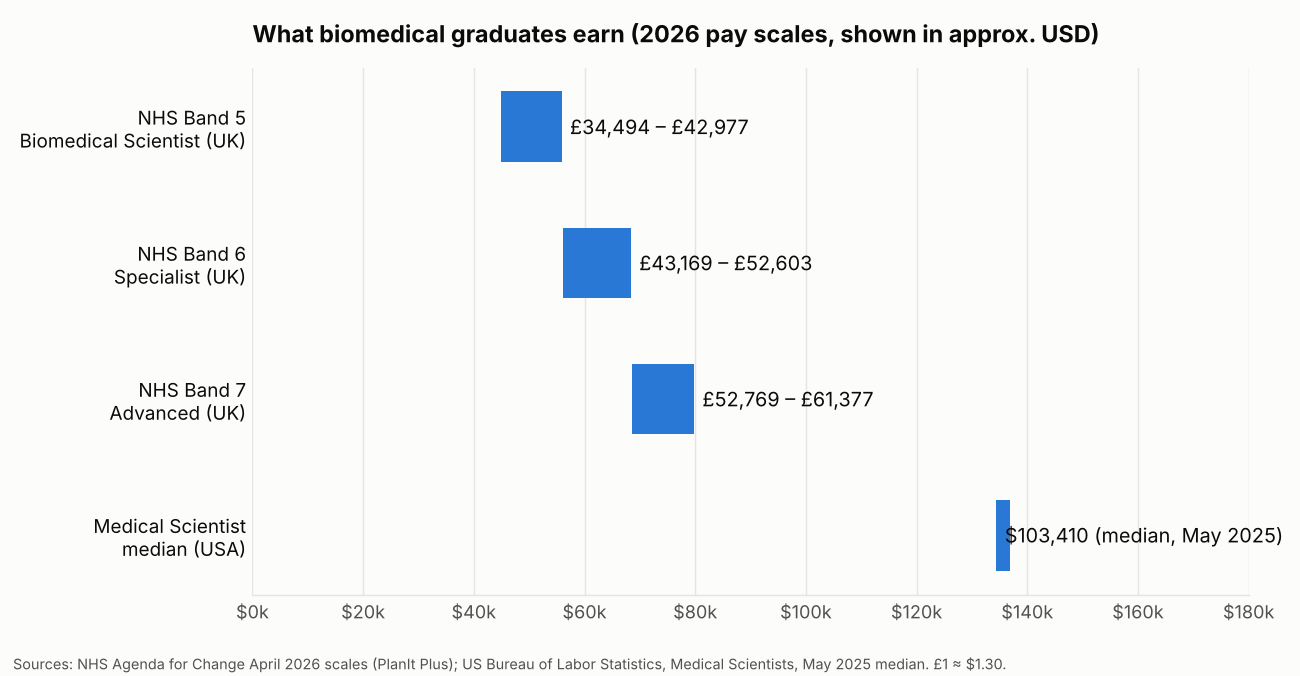
- UK: Registered biomedical scientists start at NHS Band 5 (£34,494–£42,977), move to Band 6 as specialists (£43,169–£52,603) and reach Band 7 as advanced practitioners (£52,769–£61,377). Industry roles at AstraZeneca, GSK or diagnostics companies often pay more.
- USA: Medical scientists earn a median $103,410 (May 2025) with 13% growth forecast to 2035, though most of these roles need a master’s or PhD. Bachelor’s graduates typically start as research associates or clinical laboratory technologists at $50,000–$70,000.
- Canada: Medical laboratory technologists earn CAD 60,000–85,000; you will usually need CSMLS certification, which some universities build into the degree.
- Germany: Lab scientists and pharma research associates start around €45,000–€55,000; a master’s is normal before senior research roles.
Common next steps after the BSc are an MSc in biomedical science, biotechnology, bioinformatics or public health; a PhD (often fully funded in the US, UK and Germany); graduate-entry medicine; or direct industry jobs in quality control, clinical trials, regulatory affairs and medical sales.
Common Mistakes to Avoid
- Choosing a non-accredited UK course. If you want to work in NHS labs, pick an IBMS-accredited BSc so you can register with the HCPC.
- Applying only to top-10 universities. Add two or three realistic options; biomedical science at a mid-ranked UK or US university still leads to the same NHS band or OPT job.
- Ignoring the 2027 visa change. UK graduates will have 18 months, not 24, so start networking and internships in year two.
- Underestimating living costs. London, Boston, Toronto and Vancouver are far more expensive than Leeds, Ohio, Alberta or Leipzig.
- Submitting late. Canada’s cap and UK equal-consideration deadlines punish late applications.
Frequently Asked Questions
Is biomedical science the same as medicine?
No. Medicine (MBBS/MD) trains you to treat patients. Biomedical science trains you to understand disease in the lab and run diagnostics or research. Many biomedical graduates later apply for graduate-entry medicine.
Which country is cheapest for biomedical science?
Germany, where public universities charge almost no tuition. You still need about €12,000 per year in a blocked account for living costs, and some bachelor’s courses require German.
Which country gives the longest post-study work visa?
The USA (up to 36 months through STEM OPT) and Canada (up to 3 years PGWP). The UK will offer 18 months for Graduate visa applications made from 1 January 2027.
Can I study biomedical science abroad after 12th with PCB?
Yes. Physics, Chemistry and Biology at 12th with 75–85% is the standard profile for UK, Canadian and most US biomedical programmes. Maths helps for US universities but is rarely compulsory.
Do I need NEET to study biomedical science abroad?
No. NEET is only required for medical degrees in India. Biomedical science abroad needs your 12th marks and an English test, not NEET.
How much IELTS score is needed?
Most UK universities ask for IELTS 6.0–6.5 overall with no band below 5.5. US and Canadian universities usually accept IELTS 6.5 or TOEFL 80–90; many also accept Duolingo English Test 110–120.
Can I work part-time while studying?
Yes. UK and Canadian student visas allow 20 hours per week during term and full-time in holidays. The US allows 20 hours on campus. Germany allows 140 full days per year.
Is biomedical science a good career in 2026?
Yes. Demand for diagnostics, genomics, vaccine and drug development keeps rising; the US projects 13% growth for medical scientists through 2035, and the NHS continues to recruit biomedical scientists in every region.
Final Checklist Before You Apply
- Shortlist 5–8 universities across two countries and two price levels.
- Confirm the course is accredited (IBMS in the UK) or STEM-designated (USA).
- Book IELTS/TOEFL at least four months before the deadline.
- Draft your personal statement and get two rounds of feedback.
- Prepare financial proof: 12 months of bank statements or a sanctioned education loan.
- Submit before the main deadline, not the final one.
- Apply for scholarships and accommodation as soon as you have an offer.
- Start the visa process the day your CAS, I-20 or LOA arrives.
Start early, choose the country that fits your budget, and treat the visa rules as part of your plan rather than an afterthought. Do that, and starting your biomedical studies abroad in 2026 or 2027 is very achievable.
Related guides
- How to Apply for a Master’s in Biotechnology in the USA & UK (2026)
- How to Join Medical Foundation Programs in the USA and UK
- Affordable Foundation Courses for International Students in the UK & USA
- How to Join Top Biotechnology Programs in the USA, UK & Canada
Sources: BUILA – Graduate Route changes from January 2027; UEL – UCAS deadlines 2026 and 2027; CIC News – Canada 2026 study permit cap; Cardiff BSc Biomedical Sciences fees and requirements; NKU international undergraduate costs 2025–26; ApplyBoard – German blocked account 2025/26; US BLS – Medical Scientists; PlanIt Plus – NHS biomedical scientist pay. Figures checked October 2026; always confirm on official university and government pages.