Medical foundation programs are the main route into a UK medical degree for international students who did not study A-levels or the IB, or who need one more year of science and English before an MBBS. The USA works differently: there is no “foundation year” for medicine, because US medical school starts only after a four-year bachelor’s degree. This guide explains both systems honestly, lists every UK medicine foundation course open to international students for 2027 entry with fees and progression rules, covers the UCAT, costs, deadlines and visas, and shows what the full journey to becoming a doctor looks like in each country.
Quick Summary: Medical Foundation Programs in the UK vs USA
| Question | United Kingdom | United States |
|---|---|---|
| Is there a medicine foundation year? | Yes: 9–12 month programmes at about 12 universities and pathway colleges | No. Medicine (MD) is a graduate degree; you do a 4-year pre-med bachelor’s first |
| Who is it for? | Students after Class 12 / high school whose qualifications don’t meet direct MBBS entry | Students after high school who want to become doctors in the USA |
| Fees (international) | £21,500–£31,500 for the foundation year; then £30,000–£70,000 per year for MBBS | $160,000–$360,000 for the bachelor’s; $140,000–$280,000 for the MD |
| Admission test | UCAT (some providers); MMI interview | SAT/ACT for college; MCAT for medical school |
| English | IELTS 7.0 (6.5–7.0 in each band) for most medicine progression | TOEFL 90–100 / IELTS 7.0 |
| Guaranteed medical place? | No. Progression needs 70–75% in modules plus interview | No. MD admission is separate and very competitive |
| Time to qualified doctor | 8 years (1 + 5 + 2 foundation training) | 11–15 years (4 + 4 + 3–7 residency) |
| Key 2027 deadlines | UCAS 15 Oct 2026 (Lancashire, King’s); providers up to July 2027 | College: 1 Nov 2026 (early), 1–15 Jan 2027 (regular) |
What a Medical Foundation Program Actually Is
A medicine foundation year (also called a pre-med year, international foundation in medicine, or gateway to medicine) is a one-year university-level course taken before the MBBS. It teaches biology, chemistry, maths and academic English at A-level standard, trains you for the UCAT and the multiple mini interview (MMI), and ends with an assessment. If you reach the required marks, you progress to year one of the medical degree at the same university or a partner medical school.
Two things every student should know before paying a deposit:
- No foundation course guarantees a medicine place. Bristol, for example, guarantees every foundation student an MMI interview, not a seat. Progression typically needs 70–75% in each module, IELTS 7.0, a competitive UCAT score where required, and a successful interview.
- “Gateway Year” courses with the UCAS code A104 are for UK home students only (widening-participation routes at Lancaster, Keele, St George’s and others). International students need the courses listed below.
Medical Foundation Programs in the UK Open to International Students (2027 Entry)
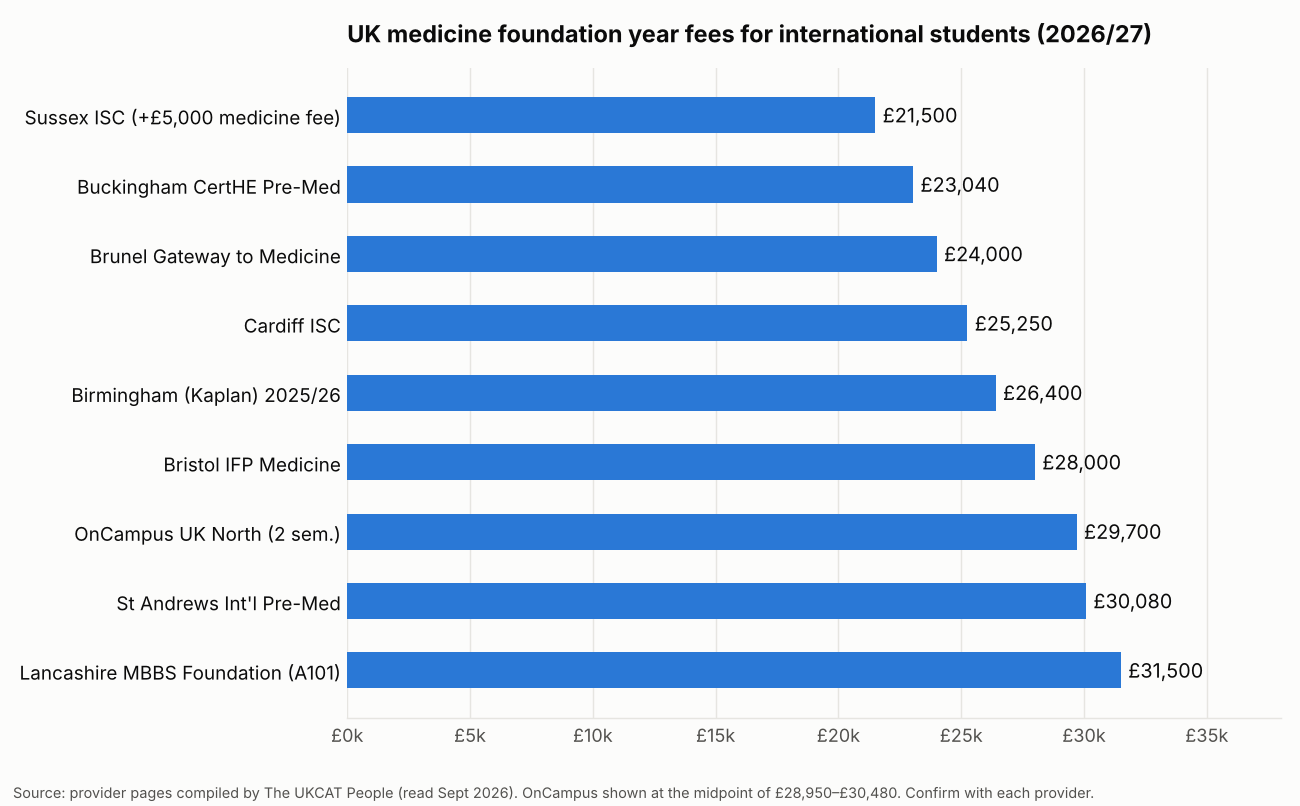
| Provider / course | Fee (2026/27) | UCAT? | Progression rule | Deadline |
|---|---|---|---|---|
| University of Lancashire – MBBS with Foundation Year (A101, international only) | £31,500, then £49,950 per year MBBS | No (MMI) | 70% in science and maths modules; 65% in Biological and Chemical Systems | UCAS 15 Oct 2026 |
| University of St Andrews – International Pre-Med (Medical Sciences) | £30,080 (9 months); 18-month Extended route £49,425 | Yes, taken in the year you start | 7.0+ in semester-one modules, 12.0 in Organic Chemistry and Human Biology, 11.0 in both communication modules, MMI | 19 Jul 2027 (starts 6 Sep 2027) |
| University of Bristol – International Foundation Programme for Medicine | £28,000 | No | Meet IFP progression marks; guaranteed MMI, not a place | Spring 2027 (check) |
| Brunel University London – Gateway to Medicine (Brunel Pathway College) | £24,000 | No | Grade B in core modules, C in the rest, IELTS 7.0, progression interview, aged 18 at MBBS start | 30 Oct 2026 for January 2027 intake |
| King’s College London – King’s International Foundation (Health, Life & Biosciences) | Not yet published | Yes, before the foundation begins | 70% overall plus interview; subject to the international cap | UCAS 15 Oct 2026 |
| Cardiff University – International Study Centre (Health, Medical & Life Sciences) | £25,250 | Check | Separate medicine selection on top of module grades; September intake only | Rolling, places limited |
| University of Sussex – ISC Foundation Year in Medicine | £21,500 + £5,000 medicine confirmation fee | Yes, SJT band 3+ | 75% in every academic module, 70% in English, MMI; selected students guaranteed a semester-two interview | Rolling, September only |
| University of Birmingham – Foundation Pathways, Medicine & Health (Kaplan) | £26,400 (2025/26) | Yes | Pass pathway; competitive interview and admissions test for MBChB | Sept, Jan and Nov starts |
| NCUK – International Foundation Year (Science & Medicine) | Set by each study centre (India, Pakistan, Nigeria, UK) | Leicester yes; Lancashire no | Lancashire: AAA incl. Chemistry + mini interview; Leicester: A*AA + EAP A* | Varies by centre |
| OnCampus UK North – Medicine Undergraduate Foundation (Preston) | £28,950–£30,480 + £450 registration | Check | Required grades + MMI; partners: Lancashire, RCSI (Ireland), St George’s Grenada, Nicosia | Rolling |
| University of Buckingham – CertHE Pre-Medical and Health Studies | £23,040, then MB ChB £45,000 per year | No (Multiple Mini Assessment at admission) | 70% overall; no second interview | Rolling |
| University of Manchester – IFP (Medicine & Dentistry) | Not confirmed | – | Government-sponsored students from Kuwait, Qatar and Oman only | – |
Fees and thresholds change every year, so confirm on the provider’s own page before you pay. The list above was checked in October 2026 for 2027 entry.
Entry Requirements for a UK Medicine Foundation Year
- Academics: Class 12 / high school with Chemistry and Biology (Lancashire asks ABB-equivalent in two sciences including Chemistry; Buckingham asks BBC including Chemistry and Biology; St Andrews wants chemistry in the final school year and graduation within the last three years). Indian CBSE/ISC students usually need 75–85%.
- English: IELTS 6.0–6.5 to start the foundation, but IELTS 7.0 with no band below 6.5–7.0 is needed to progress to medicine. For the visa you need a UKVI Secure English Language Test (SELT).
- UCAT: required by St Andrews, King’s, Sussex (SJT band 3+), Birmingham and the Leicester NCUK route. UCAT UK registration normally opens in May, testing runs July to late September, and results go straight to universities. International test fees in 2025 were about £115 (UK-based tests £70).
- Interview: almost every provider uses an MMI or progression interview. Prepare ethical scenarios, motivation for medicine, teamwork and communication stations.
- Age: most providers require you to be 18 when the MBBS starts, and 17 at the start of the foundation.
- Experience: St Andrews and most medical schools want evidence of work or volunteering with people (hospital, care home, NGO, tutoring).
The USA: Why There Is No Medical Foundation Year, and What To Do Instead
In the USA, medicine is a graduate-entry degree (MD or DO). You cannot enter medical school straight from Class 12. The pathway for an international student is:
- Bachelor’s degree (4 years) in any major, completing 14–18 pre-med courses: biology, general and organic chemistry, physics, biochemistry, maths or statistics, English, psychology and sociology, with labs.
- MCAT: a 7.5-hour exam scored 472–528. Accepted applicants typically have GPA 3.7–3.8 and MCAT 510–520. Prep takes 4–8 months.
- Medical school (4 years) via AMCAS. Only a minority of US medical schools accept international applicants, and most expect you to show funds for all four years.
- Residency (3–7 years), matched through the NRMP after USMLE Step exams.
The nearest US equivalent to a foundation program is a pathway or bridge year at a university’s international centre (for example INTO, Shorelight or Kaplan partner universities), which leads into year one or two of a biology or biomedical sciences bachelor’s, not into medicine itself. Another option is a BS/MD program (7–8 years combined), but these are extremely competitive and only a few accept international students.
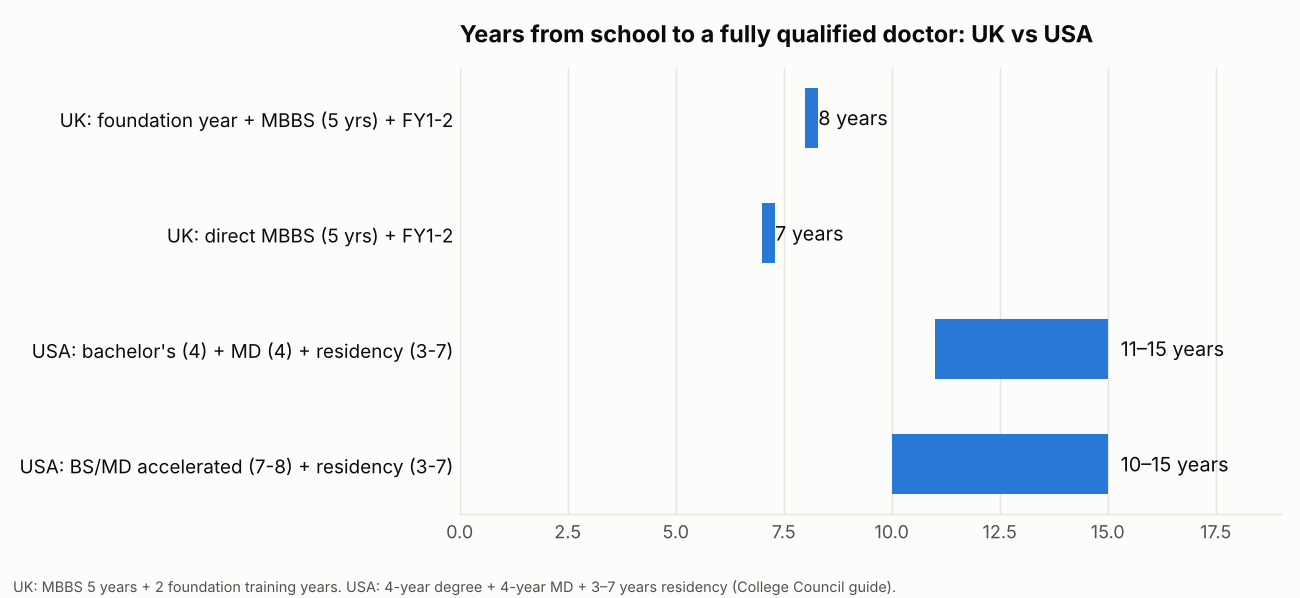
What the Full Journey Costs
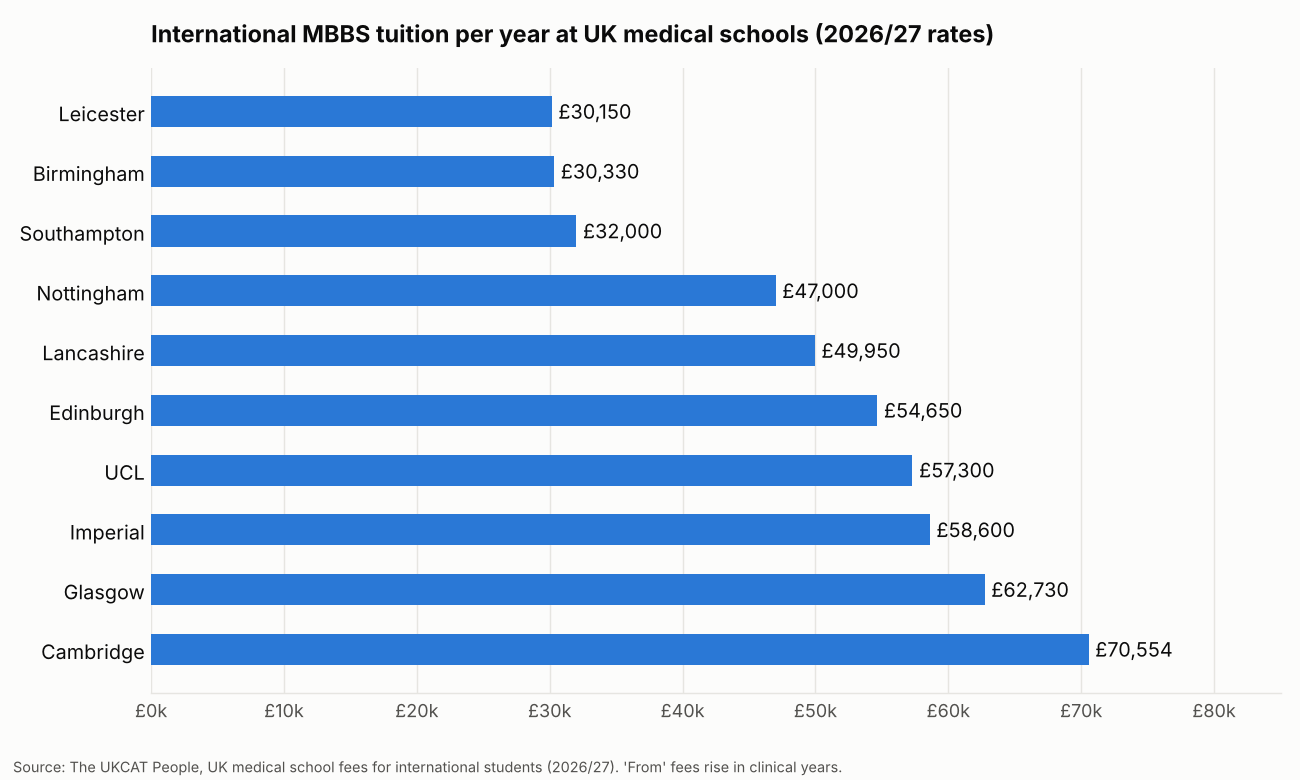
| Cost item | UK (foundation + MBBS) | USA (pre-med + MD) |
|---|---|---|
| Foundation / bachelor’s tuition | £21,500–£31,500 (1 year) | $160,000–$360,000 (4 years) |
| Medical degree tuition | £150,000–£420,000 (5–6 years; Leicester from £30,150/yr, Cambridge £70,554/yr) | $140,000–$280,000 (4 years) |
| Living costs | £12,000–£18,000 per year | $20,000–$30,000 per year |
| Visa + health surcharge | £524 visa + £776 per year IHS | $185 visa + $350 SEVIS + $1,500–$2,500 insurance per year |
| Admission tests | UCAT ~£70–£115 | SAT ~$120; MCAT ~$345 |
| Rough total to qualification | £270,000–£550,000 | $500,000–$650,000 (less with aid) |
Scholarships for medicine are rare. A few UK universities give £2,000–£5,000 international discounts; Buckingham and Lancashire sometimes offer merit awards. In the USA, a handful of private universities are need-blind for internationals at bachelor’s level, which can cut the first four years sharply, but MD programmes almost never fund international students. Most families use education loans; Indian public-sector banks lend up to ₹1.5 crore against collateral for recognised medical schools.
Step-by-Step: How to Apply for a UK Medicine Foundation Program
- Shortlist 3–4 providers using the table above. Mix one UCAS route (Lancashire or King’s, deadline 15 October 2026) with pathway-college routes that accept later applications.
- Book IELTS Academic (UKVI) for July–September 2026. Aim for 7.0 now so progression is not blocked later.
- Register for UCAT UK if your provider requires it (St Andrews, King’s, Sussex, Birmingham, Leicester NCUK). Registration opens in May; test between July and September.
- Prepare documents: Class 11 and 12 transcripts (or predicted grades), passport, personal statement (why medicine, experience with patients, resilience), one academic reference, IELTS certificate.
- Apply through UCAS (A101 courses) or the provider’s own portal (ISC, Kaplan, INTO, Brunel, Buckingham, NCUK).
- Interview: MMI or online interview, usually November–March.
- Offer, deposit and CAS: pay the deposit (typically £3,000–£5,000), receive your CAS, and apply for the Student visa with proof of first-year fees plus £1,171 per month (outside London) or £1,529 per month (London) for nine months, held for 28 days.
- TB test and SELT if required for your country, then fly for a September (or January) start.
How to Get Through the Foundation Year and Into Medicine
- Treat 70–75% as the minimum, not the target. Progression is ranked, and places for medicine are capped.
- Sit the UCAT early in the summer so you have time for a resit year if needed (you can only take it once per cycle).
- Practise MMI stations weekly from January; most providers interview in spring.
- Keep a log of volunteering, shadowing and reflections; it feeds your interview answers.
- Have a plan B: most providers let students who miss medicine progress to biomedical science, pharmacy, nursing or dentistry pathways.
Common Mistakes
- Applying to a UK “Gateway Year” (A104) that is home-students-only.
- Assuming a foundation year guarantees a medicine seat.
- Starting with IELTS 6.0 and never reaching the 7.0 needed to progress.
- Missing the 15 October UCAS deadline for Lancashire and King’s.
- Expecting a “foundation year” to lead to a US MD. In the USA you need a bachelor’s first.
- Not budgeting for the five MBBS years that follow; the foundation fee is the cheapest part.
Frequently Asked Questions
Can I study medicine in the UK after Class 12 from India?
Yes. Some medical schools accept CBSE/ISC with 85%+ directly plus UCAT; the others require a medicine foundation year first. The foundation routes above are built exactly for this.
Is a medicine foundation year worth it?
It is worth it if your school qualifications are not accepted for direct entry or you need a stronger science and English base. It costs £21,500–£31,500 and adds one year, but it comes with interview preparation and a progression route that applying cold from abroad does not.
Does the USA have medical foundation programs?
No. US medical schools admit only after a bachelor’s degree. International students do a four-year pre-med bachelor’s (or a bridge year into one), then the MCAT, then apply for the MD.
Is NEET required for a medicine foundation year abroad?
No. NEET is an Indian requirement. UK foundation programs look at Class 12 marks, IELTS, the UCAT where required, and an interview. If you plan to practise in India later, you will need to pass the FMGE/NExT after your foreign degree.
Which is the cheapest UK medicine foundation program?
Sussex ISC at £21,500 (plus a £5,000 medicine confirmation fee), followed by Buckingham at £23,040 and Brunel at £24,000. Compare the MBBS fee that follows, not just the foundation fee.
What UCAT score do I need?
Providers do not publish fixed cut-offs for foundation progression; “competitive” usually means above the national average (around 2,500 total) with SJT band 1–3. Sussex explicitly requires SJT band 3 or above.
Can I work during the foundation year?
Student visa holders on degree-level courses can work 20 hours a week in term time, but many foundation courses are below degree level and allow only 10 hours. Check your CAS.
Can I do a medicine foundation year in India or Pakistan?
Yes, through NCUK study centres, which deliver the International Foundation Year locally and connect to Lancashire and Leicester medical schools in the UK.
Final Checklist
- Confirm you need a foundation year (check direct-entry rules for your board first).
- Shortlist 3–4 programs across price and UCAT requirement.
- Book IELTS UKVI Academic and, if needed, UCAT UK for summer 2026.
- Submit UCAS by 15 October 2026 for Lancashire or King’s; provider portals by their own deadlines.
- Prepare for MMI from January 2027.
- Budget the full MBBS, not only the foundation year.
- Pay the deposit, get the CAS, apply for the visa by June–July 2027.
A UK medicine foundation program is the realistic doorway for most international students, and it is five to seven years faster than the US path. Choose the provider by its progression rule and the MBBS fee that follows, not only by the foundation price, and start your UCAT and IELTS early.
Related guides
- How To Start Biomedical Studies Abroad In 2026
- Affordable Foundation Courses for International Students in the UK & USA
- How to Apply for a Master’s in Biotechnology in the USA & UK (2026)
- How to Join Top Biotechnology Programs in the USA, UK & Canada
Sources: The UKCAT People – Medicine foundation years for international students (2027 entry); University of St Andrews – International Pre-Med; The UKCAT People – UK medical school fees for international students 2026/27; College Council – US pre-med path for international students; Fraser’s – UCAT dates and fees. Figures checked October 2026; always confirm with the provider before paying a deposit.