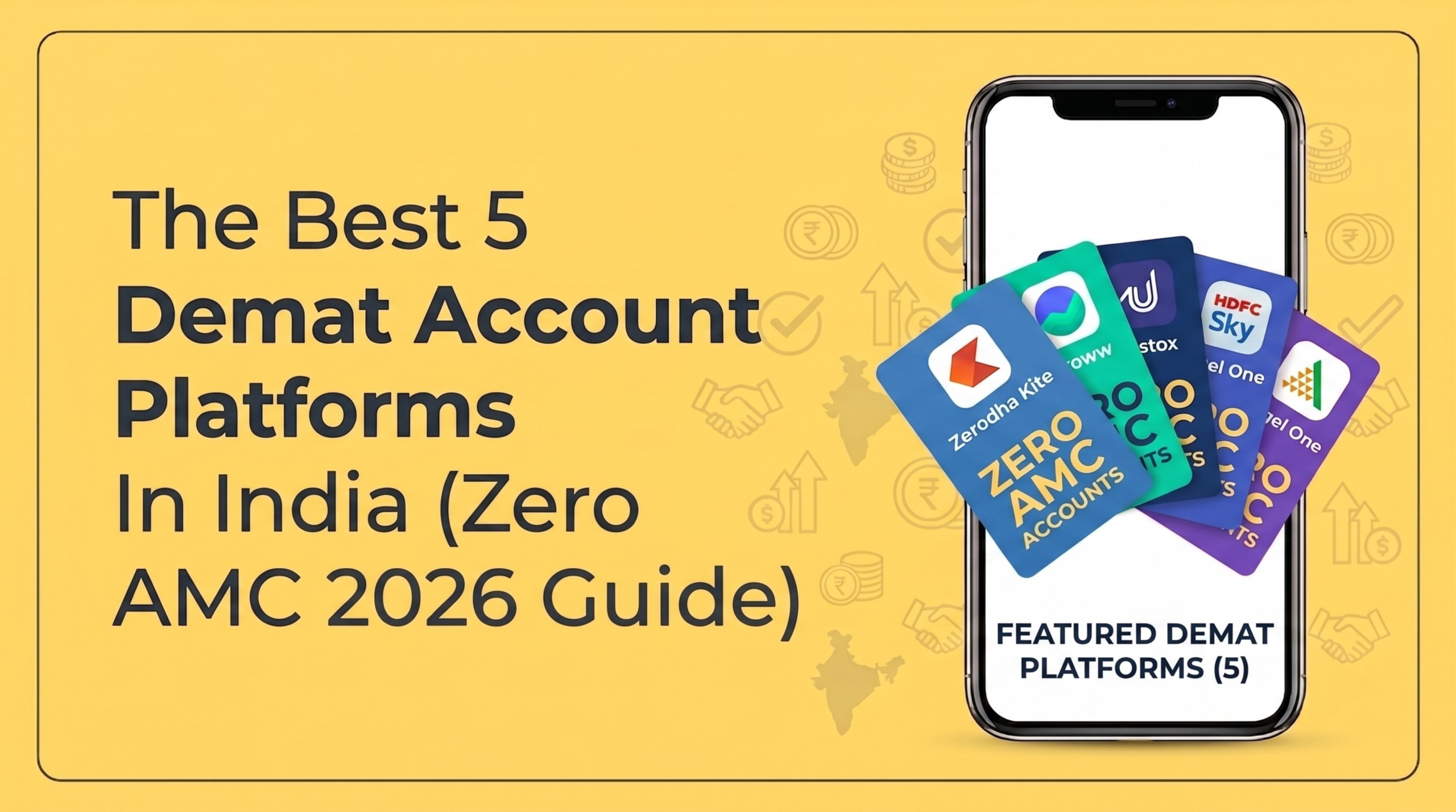
Stepping into the Indian stock market has never been more accessible, but maximizing your investment returns begins with selecting the best demat account for your specific financial goals. Traditionally, investing in equities, mutual funds, or initial public offerings (IPOs) required dealing with full-service brokers who charged massive account opening fees and hidden yearly maintenance costs. If you simply wanted to buy a few shares of a blue-chip company, the operational overhead completely eroded your dividend profits. However, the rise of powerful discount brokers and digital-first trading applications has fundamentally changed the landscape.
Today, you can open an institutional-grade investment account straight from your smartphone within minutes. Whether you are a long-term value investor looking to hold index funds, or an aggressive intra-day trader relying on technical chart indicators, avoiding high Annual Maintenance Charges (AMC) is critical. The modern fintech ecosystem allows you to leverage premium charting tools, algorithmic trading APIs, and instant market analytics without paying legacy banking fees. By strategically choosing the best demat account, you protect your capital margins and ensure that every rupee of profit stays directly in your portfolio.
Understanding the Zero AMC Demat Architecture
To dominate your personal finance goals, it is crucial to understand how modern discount brokers operate. A Dematerialized (Demat) account is essentially a secure digital vault where your shares, sovereign gold bonds, and mutual funds are electronically held. In the past, holding this vault required you to pay an Annual Maintenance Charge (AMC) regardless of whether you actually traded.
Modern investment platforms have disrupted this by offering a “Zero AMC” model. They waive the yearly maintenance fees entirely, either for a lifetime or strictly for the first year. Instead of taxing you for simply holding assets, they generate revenue through a flat-fee discount brokerage model—charging a tiny fixed amount (like ₹20) only when you actively execute an intraday trade or options contract. For standard delivery investments (buying a stock and holding it long-term), the brokerage is often completely zero. This makes finding the best demat account the most important step for both beginners and high-volume traders.
1. Zerodha: The Absolute Best Demat Account for Serious Investors
Zerodha is the undisputed pioneer of the discount broking model in India. Managing millions of active clients, it has built an ecosystem that caters to everyone from first-time college students to professional institutional algorithmic traders. When financial experts discuss the best demat account in the country, Zerodha is consistently positioned at the very top of the hierarchy.
Financial Structure and Brokerage Metrics
-
Account Opening Fee: ₹200 (Equity & Currency)
-
Annual Maintenance Charge (AMC): ₹300 per year (Free for Basic Services Demat Account holders under ₹50,000 holding)
-
Equity Delivery Brokerage: Absolutely Zero
-
Intraday & F&O Brokerage: Flat ₹20 or 0.03% (whichever is lower) per executed order
Platform Advantages and Value Matrix
The core strength of Zerodha lies in its proprietary technology stack. Their flagship trading terminal, Kite, features a minimalist, ultra-fast interface that easily handles millions of simultaneous transactions without lagging during peak market volatility. Furthermore, Zerodha integrates seamlessly with Coin (their direct mutual fund platform) and Varsity (a completely free stock market educational hub). If you want an enterprise-grade infrastructure with maximum reliability, this is the best demat account for quiet execution.
2. Groww: The Best Demat Account for Beginners and Mutual Funds
Groww specifically engineered its entire platform to remove the complexities of stock market charting, making it incredibly appealing to millennials and new investors. If you find traditional trading screens intimidating, Groww translates complex financial data into beautiful, easy-to-read mobile interfaces.
Financial Structure and Brokerage Metrics
-
Account Opening Fee: Completely Zero
-
Annual Maintenance Charge (AMC): Lifetime Zero
-
Equity Delivery Brokerage: ₹20 or 0.05% per executed order
-
Intraday & F&O Brokerage: Flat ₹20 per executed order
Platform Advantages and Value Matrix
What makes Groww the best demat account for complete beginners is its frictionless onboarding and unified dashboard. You can track your direct equities, SIPs (Systematic Investment Plans), and digital gold all in one single screen. There are absolutely no hidden AMC charges, meaning you can open the account, buy a few mutual funds, and never worry about your bank account being automatically debited for maintenance fees years down the line.
3. Upstox: High-Velocity Trading and the Best Demat Account for IPOs
Backed by heavy-hitting industrial investors like Ratan Tata, Upstox has rapidly scaled into one of the largest brokerages in India. Upstox bridges the gap between the simplicity needed by beginners and the raw data required by aggressive intraday traders.
Financial Structure and Brokerage Metrics
-
Account Opening Fee: Often Zero (under promotional digital campaigns)
-
Annual Maintenance Charge (AMC): Zero for basic plans
-
Equity Delivery Brokerage: Flat ₹20 or 2.5% per executed order
-
Intraday & F&O Brokerage: Flat ₹20 per executed order
Platform Advantages and Value Matrix
Upstox is heavily optimized for speed. Their Pro Web and Mobile application offers over 100+ technical indicators and advanced TradingView chart integrations. For users specifically interested in getting early access to startup listings, Upstox provides one of the smoothest, most reliable one-click UPI IPO application processes, easily making it the best demat account for fast primary market deployment.
4. Angel One: The Best Demat Account with Full-Service Advisory
Angel One (formerly Angel Broking) offers a highly unique hybrid model. While it adopted the low-cost discount flat-fee structure of modern startups, it still provides the premium research reports, stock tips, and expert portfolio advisory usually reserved for expensive legacy banks.
Financial Structure and Brokerage Metrics
-
Account Opening Fee: Completely Zero
-
Annual Maintenance Charge (AMC): Zero for the first year
-
Equity Delivery Brokerage: Absolutely Zero
-
Intraday & F&O Brokerage: Flat ₹20 per executed order
Platform Advantages and Value Matrix
If you want to invest in the stock market but lack the time to analyze balance sheets and quarterly corporate earnings, Angel One acts as a powerful co-pilot. They push AI-driven stock recommendations and fundamental analysis reports directly to your mobile application. Getting full-service banking research at a flat discount price makes this the best demat account for professionals who need guided wealth creation.
5. Dhan: The Best Demat Account for Options Traders and Chartists
Dhan is a relatively newer entrant to the Indian fintech space, but it has aggressively captured the advanced trading community by offering absolute bleeding-edge features built specifically for the derivatives segment.
Financial Structure and Brokerage Metrics
-
Account Opening Fee: Completely Zero
-
Annual Maintenance Charge (AMC): Lifetime Zero
-
Equity Delivery Brokerage: Absolutely Zero
-
Intraday & F&O Brokerage: Flat ₹20 per executed order (50% discount for female investors)
Platform Advantages and Value Matrix
Dhan is a technological masterpiece for chart-based traders. It allows you to execute buy and sell orders directly on TradingView charts using drag-and-drop mechanics. They offer dedicated option chains, built-in algorithmic strategy builders, and margin-pledging benefits. If your primary goal is high-frequency technical analysis, Dhan is currently the best demat account on the market.
📊 Quick Comparison Matrix for Fast Selection
| Brokerage Platform | Best Feature | Equity Delivery Brokerage | Annual Maintenance (AMC) |
| Zerodha | Ultimate Reliability & UI | Zero | ₹300/year |
| Groww | Best for Mutual Funds | Flat ₹20 or 0.05% | Lifetime Zero |
| Upstox | Advanced Charting Speed | Flat ₹20 | Zero (Base Plan) |
| Angel One | Free Research Advisory | Zero | Zero (1st Year) |
| Dhan | TradingView Integrations | Zero | Lifetime Zero |
Step-by-Step Blueprint to Open the Best Demat Account Instantly
The days of signing physical 50-page courier forms are over. You can activate your trading dashboard within 15 minutes by keeping your digital footprint organized.
-
Step 1: Digilocker Synchronization
Ensure your Aadhaar card is securely linked to your active mobile number. All premium brokers utilize the government’s Digilocker API to fetch your identity proofs instantly without requiring manual uploads.
-
Step 2: Digital Bank Verification
You will need to link your primary bank account via UPI or by uploading a digital 6-month PDF bank statement. This proves your financial stability and connects the payout rail so your trading profits can be deposited back to your main account.
-
Step 3: The E-Sign Protocol
The final step in opening your best demat account involves a digital signature. You will be redirected to the NSDL portal to securely enter an Aadhaar OTP, which legally binds the digital brokerage contract in real-time.
Common Pitfalls to Avoid While Investing
While having the best demat account protects your capital from excessive platform fees, your ultimate success relies on strict financial discipline.
Never Ignore the Hidden DP Charges
Even when a broker advertises “Zero Brokerage” on equity delivery, selling a stock from your holdings will trigger a Depository Participant (DP) charge. This is a mandatory fee (usually around ₹15.50 + GST) levied by central depositories (CDSL/NSDL) on a per-day, per-stock basis, not by your broker. Factor this into your exit strategy.
Avoid Over-Leveraging in the F&O Segment
Discount brokers make it incredibly easy to activate the Futures and Options (F&O) segment. While derivatives offer high leverage, they are highly volatile. Ensure you strictly utilize risk management stop-losses and never trade with capital you cannot afford to lose.
Monitor Dormant Account Status
If you do not execute a single trade or log into your portal for an extended period (typically 12 months), regulatory compliance requires the broker to mark your profile as “Dormant.” To reactivate it, you will need to undergo the digital KYC verification process again.
How to Build Long-Term Wealth Safely
Finding the best demat account is only the first piece of the puzzle; execution is what builds generational wealth. Rather than attempting to time daily market fluctuations, consider automating your investments through systematic SIPs.
By directing a fixed percentage of your monthly business revenue into low-cost Nifty 50 Index funds, you harness the power of compounding. Since platforms like Groww and Zerodha offer zero commission on direct mutual funds, 100% of your money is put to work in the market, shielding your portfolio from inflation and securing your financial independence.
🔗 External Regulatory Reference
Before diving into capital markets, always ensure your chosen broker is legally registered and compliant with national trading laws. You can verify broker legitimacy and read up on the latest retail investor protection frameworks directly on the Securities and Exchange Board of India (SEBI) Portal.
🌐 Internal Asset Management Reference
To optimize the cash flow you generate from your online businesses so you have more capital to invest, check out our master guides on automated workflows and business optimization right here on The Crypto Tutorial Home Page.
Comprehensive Frequently Asked Questions (FAQs)
Q1: Can I open multiple demat accounts with different brokers?
Yes. It is completely legal and common to have multiple accounts. Many professional traders use Zerodha as their primary best demat account for long-term equity investing, while simultaneously using Dhan or Upstox exclusively for daily options trading to keep their portfolios organized.
Q2: Is my money safe if a discount broker shuts down?
Absolutely. Your stocks and mutual funds are not actually held by the broker; they are secured in digital vaults managed by government-regulated central depositories (CDSL or NSDL). If a broker goes bankrupt, your shares remain completely safe and can be instantly transferred to another active brokerage account.
Q3: What documents are required for instant KYC approval?
To ensure a frictionless 5-minute approval, you only need your PAN Card number, an Aadhaar card linked to your active mobile phone for OTP verification, and a clear photo of your signature on a blank white piece of paper.
Q4: Do I need a high credit score to open a trading profile?
No. Unlike applying for an instant personal loan or a business credit card, opening a demat and trading account does not require a CIBIL score check. Since you are investing your own deposited capital, your past credit history is completely irrelevant to the stock exchange.
Q5: Can Non-Resident Indians (NRIs) open these discount accounts?
Yes, NRIs can invest in the Indian stock market, but the process is different. Standard digital accounts are for resident Indians. NRIs must open a specialized NRE/NRO linked Demat and PIS (Portfolio Investment Scheme) account, which involves slightly higher brokerage tiers and physical document verification.